Wednesday, July 29, 2015

CFL Franchise Focus: Turn of the Century Hall-of-Famers

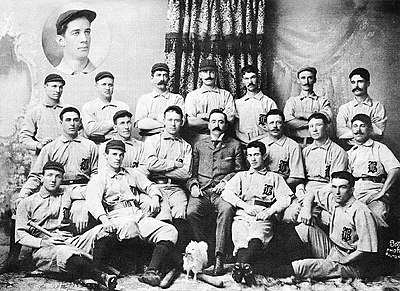
1896 Baltimore Orioles in their parlor loungewear.

This introduction to the 19th-century Hall-of-Fame team serves as both a salute and a farewell: brought in to the Classic Franchise League to provide some stiff competition for the classic franchises, they have proved to be OVERLY strong and, after some soul-searching, I have decided to remove the club from the league! After 60 games (15 games each against the 1954 Indians, the 1950 Yanks, the 1962 Dodgers, and the 1957 Braves), they are to be "retired" with a .750 winning percentage.  Before dismissing them, let's take a look at their performance:


Some notes about the batters:

- Ed Delahanty, he of the mysterious death in 1903, has been the overall hitting star. With so many great players, I didn't use a set lineup except for those players who pretty consistently delivered. He leads the club in double, homers and RBIs. Though an outfielder mainly, I mostly had him playing first base (for which he was an adequate "3"), providing some relief from an otherwise crowded outfield.
MLB-Ed Delahanty.jpg
Big bad Eddie D. channeling Tony Kubek
- George Davis was my other mainstay. He played shortstop in his career, by and large, but split his time in this league between short and third.

Photo of George Davis
George Davis and his awesome mustache

- Sam Thompson and Hugh Duffy got more time than deserved while Billy Hamilton's time was unfairly curtailed. To be fair, Hamilton's defensive rating (a '3' at all three OF positions) made me a bit nervous, particularly when installed in center.

- Cap Anson would have been a typical choice at firstbase except . . .  except I couldn't let go of my impression of him as being a prime instigator and enforcer of the so-called "color line" that prevented black players from playing alongside whites. So, I sat him. There. How do you like it, Cap? 


Pitcher observations:

- A 2.69 team ERA is awfully impressive against any competition and, of course, even more so given top-notch offenses these pitchers faced. In fact, their pitching dominance is what convinced me to pull the plug on this team just before they were about to face the 1962 Mets.

- Mickey Welch lost his last start after winning 7 straight. 

- Tim Keefe not only went 12-0 but fell one inning short of 12 straight complete games. Which shouldn't surprise anyone - in 1883 he started and completed 68 games while compiling 619 innings pitched. In one summer. I know the game was different then . . .  but c'mon! It must have been the 'stache:

Photo of Tim KeefeJamesFinlaysonPublicityHeadshot.jpg
Tim Keefe (left): inspiration for James Finlayson (right)?


So say "Hello!" and "So long!" to these 19th-century heroes (and Cap Anson). They were a fun team to manage and a victim of their own success. Had they won 2 of every 3 (as opposed to 3 of every 4) I quite likely would have kept them in the league.


Wednesday, July 8, 2015

CFL Franchise Focus: 1954 Cleveland Indians

A great team (their 111-43 regular season record was the best AL record for about 50 years), the 1954 Cleveland Indians are currently the hottest team in the Classic Franchise League. The Indians, as a franchise, did NOT follow the American League plan of the 50s, which is to say that they DID take advantage of the then newly-available talent in the black and Latino populations. By signing and fostering players like Larry Doby, Bobby Avila, Al Smith, and Mike Garcia, the Indians (well, they still have some work to do with respect to multi-culturalism, don't they?) assembled a team that, year-in and year-out, competed with the vaunted, and slow to integrate, Yankees. In 1954, Cleveland bested the Yanks by 8 games, easily outpacing the best record of the Stengel-era New Yorkers (their 103 wins that year was Casey's high-water mark). It is interesting to note that the only two non-Yankee pennant winners from 1949 though 1964 were both managed by Al Lopez, himself the son of Spanish immigrants. Lopez guided these Indians and the 1959 Chicago White Sox, Chcago being the other AL franchise that integrated aggressively.

So, what, exactly, do I mean by "hot?" They have just taken four of five from the 1962 Dodgers after taking five of seven from the very powerful 1957 Milwaukee Braves. In a league known for its parity (excluding the Hall-of-Fame 19th-century team and the hapless 1962 Mets), an 9-3 run is quite notable. Indeed, with a bit of luck, they could be on a very impressive 12-game winning streak; take a look at the three losses:

- a 5-4 loss to the Braves as Milwaukee exploded for a 4-run, 9th-inning outburst against the normally reliable Don Mossi,

- a 1-0 loss to Warren Spahn and the Braves,

- a 2-1 loss in ten innings to Don Drysdale and the Dodgers.

Some highlights from this run which has improved their record form 46-44 to 55-47:

- Bob Feller, by 1954 a shell of his former self and a spot starter, has revived and gone 7 innings on three occasions, never giving up more than 1 run. He lost to Spahn in the game mentioned above, striking out 8 in his 7 innings. Feller's contributions are the icing on an awesome cake - the 1954 Indians feature one of the great pitching staffs of all time, with top-notch starters Bob Lemon, Mike Garcia, and Early Wynn.

- Lemon has pitched well and contributed with the bat, going 2-3 with a walk, a double, and 4 RBIs in one game while adding a 2-4 plate performance in another.
Bob Lemon, SP
(Bob Lemon photo courtesy of http://bleacherreport.com/)

- In one game, Garcia retired the first 22 Dodgers in a row, taking a perfect game into the 8th inning. Then he allowed his first baserunner, hit, and run in one blow - a homer by Ron Fairly to spoil the historic outing - but settled for a glorious 2-hitter against LA.

- Art Houtteman, the number 4 starter on this team, ran his record to 8-2 in a recent stint against Johnny Podres and the Dodgers.

Cleveland manager Al Lopez kneels down alongside his four prime pitching horses, from left: Bob Lemon, Bob Feller, Mike Garcia and Early Wynn. In a career loaded with frustrating second-place finishes, Lopez guided the 1954 Indians to a dazzling, record-setting 111-43 records.
(courtesy http://www.thisgreatgame.com/)

- What about the batters, you say? Al Rosen has been a beast throughout the streak, collecting 14 hits in the seven games against the Braves. In the finale, he went 5-5 with a walk while hitting for the cycle and driving in the go-ahead run in the 10th inning.


(Al Rosen showing how a 50s manly man can handle six bats.
Photo courtesy of http://www.dailyspeculations.com/)

- Second-line players like Sam Dente, Wally Westlake, and Bill Glynn have made critical contributions. Each has hit a go-ahead homerun during this streak. Of this group, only Westlake could be considered a power threat - his 11 homers in 240 at bats in 1954 were on par with his career numbers.

- These Indians know the value of a walk: two 8 walk-games and two 9-walk games led to three blowouts and a curious 5-4 loss. In that game, Braves pitcher Bob Buhl managed to give up 8 hits and 8 walks while still managing to limit the Indians to just 4 runs scored. Perhaps his 10 strikeouts had something to do with that.

As in real-life, the replay Indians have combined strong starting pitching, effective relief, and an "Earl Weaver" offense (one that features lots of walks and power up and down the lineup) to create a top-notch team. Even the weak hitters contribute: Check out the card for George Strickland, a .213 hitter who manged to wrack up 55 walks in about 360 at bats.


It's been great fun seeing 50s stars like Lemon, Rosen, and Doby (failed to mention his team-leading 20 HRs, 50 RBIs, and 56 runs scored, though he's been relatively quiet during this stretch) perform so admirably and a real treat to see timely support from the bench players. One of the pleasures of handling a Strat-o-matic team over the course of so many games (now over 100!) is the intimate knowledge one gets for virtually all players on the roster.

Tuesday, June 30, 2015

League Overview - Classic Franchise League Extended

So, here's a little background on one of my many Strat-o-matic leagues: The Classic Franchise League - Extended.

It's a funky league - a weird amalgam of two previous leagues along with an 'expansion' team. From March of 2009 to May of 2011, I had played a 59-game season, with these teams:


Even THAT league was funky as I started with several others and allowed some to drop out as I lost interest and changed focus. I also had a "60s League" that ran for some time. I folded that league as my desire to add in advanced features made this basic-only set of cards less and less attractive. Still there were some great teams and interesting players:


I grabbed 4 of the top 5 in the Classic Franchise League (not the 1962 Giants for reasons i can't recall!), added in the 1962 Mets from the 60s league, and created a Hall-of-Fame team (the aforementioned expansion team) with players from the 19th-century. I modified the basic cards to include error ratings and throwing arms. I allowed all of the previous stats to roll over, including wins and losses, and figured out a way to get all 6 teams to about 150 games each. In September of 2011, I began playing and, as of June, 2015, the standings look like this:


Each team gets walloped by the HOF team but gets healthier beating up on the Mets. I don't expect any team to outpace the HOF team but I am extremely interested in the 150-game stats that will, eventually, be generated.

Some highlights:

- Frank Howard (.336), Red Schoendienst (.333), and Tommy Davis (.333) are battling for the batting title.

- Hank Aaron leads the league with 34 homers with Howard a distant second at 24.

- Maury Wills has 61 stolen bases; about 1 every 6 at bats which puts him on pace for 100 in his 150 game schedule.

- Warren Spahn is 14-7, well on his way to a 20-win season. Which, if you're familiar with Warren Spahn, should come as no surprise.

- Tim Keefe, of the 19th-century HOFers, is now 11-0.

- Ed Delahanty, also of the 19th-century team, leads the squad with 37 RBIs, 15 doubles, 5 homers, and a .346 batting average. He has yet to meet the minimum number of at bats to qualify for the batting title.

- Bob Miller (6-6) and Al Jackson (5-9) have accounted for 11 of the 1962 Mets' 14 victories. That makes the rest of the staff 3-53 . . .  gulp. 

It's been great fun: my emerging familiarity of the stars of the 1800s, witnessing, first-hand, the trials and tribulations of the 1962 Mets, being caught up in the excitement of scrubs becoming white-hot for short, exhilarating spells, and so much more. Playing a long-term project like this can feel a bit daunting but, as the season slowly builds, there's a great sense of joy and fascination. 

Monday, June 29, 2015

Musings on Mets Mismatches - 1962 Strat Style

As most of you know the 1962 New York  Mets were a bad baseball team. Very bad. They lost 120 games and lost them in spectacular fashion.

(courtesy http://2guystalkingmetsbaseball.com/)

They were the by-product of a miserly National League draft system, allowing the existing NL teams to protect virtually any player of value and guaranteeing that the expansion Mets (and their brethren the Houston Astros, then called the Colt-.45s) would be bad.

Here's Casey Stengel, Mets manager and media distraction, showing the Mets infielders (Don Zimmer, Elio Chacon, Charlie Neal, and Gil Hodges) the way to the stadium. Photo courtesy of NY Times.

These Mets are an entertaining team to play in a Strat-o-matic league. Some players have some skills but, as a rule, they are a deeply flawed group of players. Elio Chacon can draw a walk but can't actually hit and plays a miserable shortstop. Richie Ashburn is a fine outfielder and can hit .300 but is at the end of his career, needs frequent rest, and can't cover ground in the outfield like he did in his heyday. They do not have a catcher who can hit or throw. Pitchers Al Jackson and Roger Craig were serviceable starters who had worthy careers but each needs a good defense behind him to win . . .they were backed by a terrible D and lost. A lot. It's not uncommon for a pitcher to need to get 4 outs in an inning with the 1962 Mets.

They are one of six teams in a long-running league that has morphed over the years to include the 1957 Braves (Aaron, Mathews, Spahn, etc.), the 1954 Indians (Lemon, Garcia, Wynn, Doby, Rosen, etc.), the 1950 New York Yankees (Dimag, Berra, Raschi, Lopat, Reynolds, etc.), a Hall-of-Fame team featuring players of the late 19th century (Ed Delahanty, Sam Thompson, Hugh Duffy, et al) and the 1962 LA Dodgers (Koufax, Drysdale, Wills, Davis, etc.).

Against this assemblage of talented teams, it's not surprising that the Mets are currently 14-68 for a .171 winning percentage. They are routinely mismatched but recently they faced perhaps the most lopsided pitching match-up I've ever seen:

Photo of Sandy KoufaxPhoto of Jay Hook

Sandy Koufax vs. Jay Hook.
(11-6)                    (0-12)

That's Jay on the right. Koufax, of course, needs no introduction though one should know that his relatively modest W-L record is the result of the Dodgers having recently played 15 games against the HOF team - his record against the other teams in this league is something like 10-3.

It didn't go well.  The Dodgers jumped on Jay for 6 runs in 2+ innings, then mauled Mets relievers for 10 more runs as Koufax tossed a 3-hitter.  The final score was 16-2. The Dodgers slammed EIGHT homeruns and walked 10 times.

The next day it didn't get any better:

Photo of Don Drysdale


Don Drysdale (10-9)


vs.

Photo of Bob MoorheadBob Moorhead (1-5)


Drysdale tossed a 5-hit shutout while the LA offense settled for single touchdown in a 7-0 win.

Up next for the Mets? Their 15-game set against the 19th-century Hall-of-Famers who currently sport a 45-15 record!  This could get ugly! Or, uglier . . .

Andy Carey's Best Week Ever!

One of the joys of Strat-o-matic baseball is that all kinds of fantastic things will happen; even to the most ordinary players. Like Andy Carey . . .
Photo of Andy Carey

Andy Carey was a fine player - heck, he was a major leaguer which is more than 99% of us can say - but never an all-star, never a feared player. He had the good fortune of being drafted by the Yankees and playing for them in the 50s. Which meant, of course, that he was blessed - the Yankees routinely went to, and won, the World Series in the 1950s. Andy played third base on the days that Casey Stengel could remember his name. Strangely, he only played third base for Casey. I say strangely because Casey would take guys like Bobby Brown, Billy Johnson, and especially Gil McDougald and sprinkle them around the infield willy-nilly and expect them all to turn the DP. Which they did for reasons no one really knows . . .  some form of Casey magic, I suppose. Anyway, Andy played third, hit .302 one year, hit 11 triples to lead the league another, and only once compiled as many as 500 at bats. To summarize his career, I'll indulge in one advanced metric: his career OPS+, a relative measure of a player's value, was 97. An OPS+ of 100 is the average value. . .  Andy Carey was a perfectly ordinary major league baseball player.

Which is my point.


By 1962, Andy was finishing his career in LA with the Dodgers. He was 30 and hit .234 in 111 at bats. Ordinary. Those Dodgers are part of a long-running Strat league of mine and Andy has a card only because I made one for him. I wanted a larger roster than the 20 cards provided by Strat and Andy came to life along with Lee Walls, Tim Harkness, and Phil Ortega. In this league, there are daily and long-term injuries. The Dodgers were sent reeling with long-term injuries to Willie Davis and Ron Fairly and suffered several daily injuries in a 9-game set with the infamously bad 1962 Mets. Every day there were at least three regulars unavailable, forcing me to reach deep into the pile to find Andy Carey.

Andy made cameos in the first two games, pinch-hitting and making out in each game. He started the third game, went 2-3 with a homer, a walk, two runs scored, and three RBIs. Pretty good day for ol' Andy. But he was just getting started . . .

Over the course of the next six games, Andy had a career! He had the mojo workin' . . . Thirteen more hits! Seven more runs scored! Nine more RBIs! And, get this, four more homeruns, one each in the last four games of the series! (Please don't spoil it for him - or me - by pointing out that this was all accomplished while batting against one of the worst teams of all time . . .) Here's his complete line for the nine games:

15 hits in 32 at bats
9 runs scored
12 RBIs
1 double
5 HRs
3 walks

The impact of this week on his seasonal stats (the Dodgers are now 53-44) was to change his slash stats (average/on-base percentage/slugging percentage) from .188/.291/.292 to .308/.380/.577 which means, basically, that Ordinary Andy Carey became Willie Frackin' Mays for one glorious week, 53 years after he retired.

On a team with Maury Wills, Sandy Koufax, Don Drysdale, Tommy Davis, and Frank Howard, Andy Carey was THE story for a remarkable seven-game run. I like to think that Andy was paying back Casey, sitting in the 1962 Mets' dugout, for not remembering his name more frequently!