Sunday, April 3, 2016

CFL Countdown: The End is Here

And so it comes to this: 

The 1950 New York Yankees have a record of 88-64 and two games left with the 1957 Milwaukee Braves.


courtesy baseball-refernce.com


Left to right: Rizzuto, Berra, Dimaggio, Lopat, Reynolds, Raschi, Coleman, Ford, Bauer, Woodling, Mize, and Byrne.

The 1954 Cleveland Indians own a record of 88-65 and will play the final game on the calendar against those very same Braves.


courtesy baseball-refernce.com
Left to right: Avila, Doby, Wynn, Lemon, Rosen, Garcia, Smith, Mossi, Narleski, Houtteman, Feller, Wertz

A tie at the end of the season would set up a best of three playoff.

Let's get to the games!

The Yanks send wildman Tommy Byrne (10-12) to the mound to face spot starter Bob Trowbridge (7-12) as the Braves' starter Gene Conley comes up lame in his last scheduled start of the year. Things look good for the New Yawkers as they score 2 in the second and another pair in the top of the third. Byrne, however, has trouble getting anyone out in the Milwaukee third, giving up 3 hits and 2 walks before yielding to Allie Reynolds. Big Chief Reynolds calmed things down but the Braves score 5 (including 3 on Hank Aaron's league-leading 45th HR) to take a 5-4 lead.

Yogi Berra sends the Yanks up again with a 2-run homer in the fourth and, for a while, it looks like those runs might be enough. Reynolds provides 5 innings of stellar relief but surrenders the tying run in the 6th, as Eddie Mathews doubled home Red Schoendienst. Meanwhile, a trio of Milwaukee relievers shut down the potent NY offense - Ernie Johnson, Juan Pizarro, and Don Mcmahon keep the Bombers scoreless through the 8th.  Joe Ostrowski comes on for the Yanks - he's got a league-leading total of 20 saves on the year. The Braves tee off on Ostro for 4 hits and Bobby Brown commits an error all good for 2 runs and an 8-6 lead. Don McMahon completes the 9th without incident and the Yanks go down to defeat.

WP: Don McMahon 7-2
LP: Joe Ostrowski 5-8

NY 88-65
CLE 88-65

Tied with one game left for each team in the season.

The Yanks' last game of the year was a laugher. They jumped on hard-luck Braves' hurler Lew Burdette (4-22) and his second-inning replacement Dave Jolly for 11 runs. Vic Raschi cruised into the 9th but needed last out help from Tom Ferrick. Final score 11-6.

WP: Vic Raschi 15-11
LP: Lew Burdette 4-23
Lew Burdette - wondering how it could have gone so wrong this year!


NY 89-65
CLE 88-65

Cleveland must win the final game of the season to force a playoff.

Ace Bob Lemon takes the mound for Cleveland while the Braves send 17-game winner Bob Buhl out to thwart the Indians. Lemon falters in the first, giving up 6 hits and 5 runs. This, combined with the fact that Cleveland is playing without their starting 2B (Bobby Avila), C (Jim Hegan), and LF (Al Smith) has quieted the visitors' dugout ... the season seems lost. 

But the game must go on and Cleveland shows signs of life: Wally Westlake doubles and scores in the second, Larry Doby triples home Hank Majeski in the third, and Al Rosen singles and scores in the 6th. Meanwhile, Lemon has regained his composure and pitches 6 innings, leaving for a pinch-hitter in the 7th on the wrong end of a 7-3 score. Things go from bad to worse as Red Schoendienst homers in the bottom of the 7th, putting Cleveland down by 5 with just two innings to go.


In the top of the 8th, the Indians come alive, getting to Buhl for a series of hits. Westlake homers, scoring himself and Vic Wertz. SS George Strickland walks and scores moments later when backup catcher Hal Naragon triples. Dave Philley doubles home Naragon and, when Doby singles him home, it's 8-8!! The Indians have improbably stormed back and are very much alive in the pennant race as we head into the final few innings.

Ace reliever Don Mossi retires the Braves in order in the bottom of the 8th and Ernie Johnson duplicates that effort, quieting the Tribe in the 9th. Tied at 8, we go to the bottom of the 9th in the final game of this remarkable season!

Mossi retires Billy Bruton and Hank Aaron and it looks like we're headed for extra innings. Slugger Eddie Mathews is pitched to carefully; he works a walk. Andy Pafko lifts a short fly to center which drops in; first and second with 2 outs. Mossi faces yet another Braves' slugger in Joe Adcock. When Adcock walks, it loads the bases for SS Johnny Logan.


Just two of the Braves Fence Busters
courtesy carboardconnection.com

Mossi, and Cleveland fans everywhere, couldn't have asked for a better situation - given the depth of the Braves' potent offense (three Hall-of-Famers, six players who, at some point in their careers hit 25 homers in a season, five of whom reached the 35-homer mark),  the prospect of facing Johnny Logan with the season on the line is pretty appealing. Mossi holds the ball and considers his good fortune.
Honestly .. one of the better pics available of the esteemed Mr. Mossi.

Bottom of the 9th, bases loaded, two out .... pennant on the line. An out extends the game, the season, and the hopes for Cleveland's fans. A hit, walk, or error ends it all with Cleveland one game back of the Yankees. A high-leverage moment, indeed.

Mossi reaches back and delivers to Logan. Logan drives it right back up the middle, past Mossi, between Majeski and Stickland and, as the ball bounces over second base, Eddie Mathews scores!!
Logan's Run ends the season and dashes Cleveland's hopes
Braves win, Cleveland loses, and the Yankees win the pennant!! And a season which took seven years to complete, ends on the very last roll. 

Final Standings:


YEAR TEAM WINS LOSSES PCT G.B.
1950 New York Yankees 89 65 0.578 0
1954 Cleveland Indians 88 66 0.571 -1
1962 Los Angeles Dodgers 81 73 0.526 -8
1957 Milwaukee Braves 72 82 0.468 -17
1962 New York Mets 38 116 0.247 -51


Wednesday, March 23, 2016

CFL Countdown - The End is Near

Home of the Braves, land of the free
Milwaukee's County Stadium will be the site of the final ten games of this magnificent season, with the top two teams - the 1950 New York Yankees and the 1954 Cleveland Indians - taking turns at the battered and beaten Braves of 1957. Here's how it will all wind up:

Yanks versus Braves for 1 game
Indians versus Braves for 2 games
Yanks versus Braves for 2 games
Indians versus Braves for 2 games
Yanks versus Braves for 2 game
Indians versus Braves for 1 game

The Indians and the New Yorkers come in with identical 85-64 records. Cleveland blew an opportunity to come in with a superior record but could only manage a split of their four-game series with the 1962 Mets who finished their season with a 38-116 record (.247). 

The Braves have staggered some (winning only 21 of their last 53 has turned a 48-42 record into a disappointing 69-75) and have been injured a lot. They've lost significant time to injuries in the past month of the season including Andy Pafko for 2 games, Wes Covington for 2, Warren Spahn for 6, Hank Aaron for 8, Eddie Mathews for 10, and switch-hitting 2B Red Schoendienst for 11 games. That's 35 games lost to four Hall-of-Famers!! Everyone's back off the DL, so the Braves, though tender, will have a full roster for the start of these important games.

Let's get to the games:

Yanks 5, Braves 4


Photo of Hank Bauer
Hank Bauer, happy to be here
Yanks' starter Vic Raschi got into a 2-0 jam after just two batters - Red Schoendienst doubled and was brought around by a Johnny Logan homer. Two subsequent errors went to waste as the Braves could not convert these early gifts into more runs. Pity, too, as Hank Bauer poled a 3-run homer in the third to give NY the lead. The teams traded runs and went into the 8th tied at 4.  Johnny Mize, New York's red-hot first-baseman, clubbed his 29th homer of the year for the lead . . .  and the win. 

WP: Vic Raschi 14-11
LP: Lew Burdette 4-21

YEAR TEAM WINS LOSSES PCT G.B.
1950 New York Yankees 86 64 0.573 0
1954 Cleveland Indians 85 64 0.570 -0.5
1962 Los Angeles Dodgers 81 73 0.526 -7
1957 Milwaukee Braves 69 76 0.476 -14.5
1962 New York Mets 38 116 0.247 -50

Indians 10, Braves 2

Bob Lemon knows something you don't know ... and he's not tellin'
Bob Lemon picked up his 16th win while battery-mate Jim Hegan clubbed his 26th HR of the year and drove in 4 runs. Cleveland scored early and often and drove Milwaukee starter Bob Buhl from the mound after 5 innings. With the win, the Yanks and Cleveland remained tied with 86-64 records.

WP: Bob Lemon 16-12
LP: Bob Buhl 17-8

Braves 6, Indians 3

Reaching back for that something extra: Warren Spahn!
To say that lefty Warren Spahn survived a shaky start wouldn't quite be right ... true, he gave up 3 runs in the first three innings but he was never comfortable on the mound. He surrendered 16 hits and 2 walks in his 9 innings of work and, magically, incredibly, walked away with a win. In so doing he became the league's first - and likely only - 20-game winner. Spahnnie also collected two hits and drove in a run.

WP: Warren Spahn 20-14
LP: Art Houtteman 10-6

YEAR TEAM WINS LOSSES PCT G.B.
1950 New York Yankees 86 64 0.573 0
1954 Cleveland Indians 86 65 0.570 -0.5
1962 Los Angeles Dodgers 81 73 0.526 -7
1957 Milwaukee Braves 70 77 0.476 -14.5
1962 New York Mets 38 116 0.247 -50
Yanks 6, Braves 2
Yanks 2, Braves 1

Hey Yogi! Whaddaya wanna do? I dunno, Phil... whadda you wanna do?
Eddie Lopat stymied the Braves on 6 hits in the first game while Whitey Ford hurled 8 shutout innings before yielding a solo run in the 9th inning of the second game as the Yanks swept their two games against Milwaukee. "The Scooter," Phil Rizzuto picked up 5 hits in the two games, three of them for extra bases.

WP: Eddie Lopat 18-8
LP: Gene Conley 8-5

WP: Whitey Ford 10-5
LP: Lew Burdette 4-22

Indians 5, Braves 3 (11 innings)
Indians 11, Braves 3
Three Hall-of-Famers and the CFL's Cy Young Award winner???
Cleveland came right back to match the Yanks' sweep. Mike Garcia pitched 10 strong innings for Cleveland and Bob Buhl pitched a beaut for Milwaukee. Cleveland's back-up RF Wally Westlake broke the deadlock in the 11th with his 20th homer of the year - his 4th hit of the day! The victory was a costly one, however, as the Indians lost their stalwart catcher (Jim Hegan) and their star second-baseman (Bobby Avila) to injuries which will keep them out of the lineup for the final few games.

Early Wynn then mesmerized the Braves, giving up just 4 hits (including a shutout-spoiling 3-run HR by Andy Pafko) in the complete-game, 11-3 rout. Given their injuries, the Indians wisely sat some of their regulars after getting a 10-0 lead after three innings. Unfortunately, it wasn't 100% effective; Al Smith, left-fielder and lead-off man, went down with yet another season-ending injury, leaving the Indians down by three starters, with just one game left. 

WP: Mike Garcia, 19-5
LP: Bob Trowbridge 7-11
SV: Ray Narleski (7)

WP: Early Wynn 12-15
LP: Warren Spahn 20-15

YEAR TEAM WINS LOSSES PCT G.B.
1950 New York Yankees 88 64 0.579 0
1954 Cleveland Indians 88 65 0.575 -0.5
1962 Los Angeles Dodgers 81 73 0.526 -8
1957 Milwaukee Braves 70 81 0.464 -17.5
1962 New York Mets 38 116 0.247 -51


The Yanks come in for two final games before Cleveland ends the season with one last game. New York, with two wins, can make that last game meaningless. 

After seven years of play, this league comes down to its final three games . . . 


Sunday, February 14, 2016

Me and Lou - a 40-year Strat Relationship

This past July commemorated the 76-year anniversary of Lou Gehrig's "Luckiest Man" speech at Yankee Stadium. For the past several months, I've been thinking about Gehrig, his phenomenal 1927 season, and his equally impressive Strat-O-Matic card from that year:


This is the basic-only card originally available as part of Strat's spectacular 42-team, Old-timer set. I first purchased this set in 1972 or so and have bought the entire set two more times since then. The later purchases provided me with cards that had the by-now-standard black ink on white card printing, but the '72 purchase arrived with teams having the distinctive shade of blue ink shown above.

It's a great card from one of the best offensive seasons ever. A .373 batting average with 109 walks results in a near-.500 on-base percentage. The extra base hit barrage of 52/18/47 is a wonder to behold. And Strat's conversion of all that into a card is a thing of beauty - the solid HRs on 3-4, 3-5, and 3-6 are both rare and yet not-quite enough, necessitating a minor split on 3-7. Indeed, the "HOMERUN 1, DOUBLE 2-20" result provided me with one of my first hints as to the precision of Strat-O-Matic's work: it seems almost unnecessary and yet they included it to make...his...card... juuuust .... right. A truly epic season crafted into an aesthetically pleasing card. Plus, as a bonus, Lou's card was the only one of its kind (until some Strat policy changes years later): it was free of injuries. Every other player's card contained a result - often in the infrequent 2 or 12 slot for those who were regulars - that would injure a player for anywhere from a moment to a maximum of 15 games. But Lou, in the midst of a historic game-playing streak that would eventually reach 2130 straight games, was exempt from this probability. I loved that Strat understood that about Gehrig and created a card that respected - and captured - his achievement.

All of those aspects could be appreciated about that card as soon as it was delivered. But, now, after 40+ years of playing and handling, there are additional layers of appreciation ... layers that reveal the interaction of the ball-player and the game-player.

Take another look at the card. Notice the curve along the left-hand edge? That's where the card, along with its teammates in a lineup of nine, rested against the opposable-thumb muscle of my left hand. The right-hand side curves? Those are the slight impressions created by the slow carving of curled fingers that kept it in place, at bat by at bat, game by game, season by slowly-evolving season.

How 'bout them stains? There are two prominent ones, set diagonally across from one another. On the upper left, one can see the accumulation of dirt, grime, and oils deposited over eons as my left-hand thumb pushed down on the card, then pushed to the right when an at bat came to an end. The matching browning on the lower right-hand side is the same effect produced by the right-hand thumb finishing the transaction, retrieving the card and bringing it to the bottom of the 9-card lineup. Many of the cards from that set show these signs to some degree but Lou's card, always in the lineup, shows them to the greatest extent.

What you can't tell from the photo is the feel of the card. When they first arrive, the cards often stick together due to a slightly waxy finish. After a few games, a satisfying slip sets in and the cards move more freely. After a thousand games - and that is by no means an exaggeration in the case of this card - the card takes on a velvety smoothness and becomes noticeably slimmer as, tiny layer by tiny layer, a river-rock erosion takes place.

As I think about the sloughing of the card's outer layers over time, I can't help but think about the similar impact this action has had on my fingers ... we know our skin sheds its outermost layers and this constant sliding of fingers and thumbs against Strat cards must accelerate that process. Somewhere those atomic bits of skin and paper are mingling. Indeed, there must be a trail of such erosion, from the living room and kitchen of my parents' apartment in New York City to the dormitories of Syracuse University and the steady stream of the Boston apartments of my 20s and ultimately to the shared spaces with my wife in Vermont ... a 40-year trail of Strat detritus.

I never met Lou Gehrig, obviously; his untimely death in 1941 is part of the mythology of baseball and America. But, through Strat-O-Matic, I've had a relationship with him. While I have grown and changed over time, he has been constant, static, and unchanging while somehow also slowly altering - softening and slimming - through a lifetime of interactions. Our time together is evident on his card; one of the few cases where the impact of a relationship can be visualized.   
Lou Gehrig - a good man to hang out with
courtesy of sabr


Saturday, February 13, 2016

Down to the Wire in the CFL!!

A league seven-years unfolding has come down to the final few games ... 

With just a handful of games left in a 154-game schedule, the Classic Franchise League standings look like this:

CFL EXTENDED LEAGUE STANDINGS
YEAR TEAM WINS LOSSES PCT G.B.
1 1954 Cleveland Indians 83 62 0.572 0
2 1950 New York Yankees 84 63 0.571 0
3 1962 Los Angeles Dodgers 76 72 0.514 -8.5
4 1957 Milwaukee Braves 69 75 0.479 -13.5
5 1962 New York Mets 36 110 0.247 -47.5

As in real-life, these Yankee and Indians teams from the 50s are quite well-matched. Each team features top-notch starting pitching (Vic Raschi, Allie Reynolds, and Eddie Lopat for NY, Bob lemon, Early Wynn, and Mike Garcia for Cleveland), excellent everyday players (Yogi Berra and Joe Dimaggio lead NY while Larry Doby and Al Rosen have taken turns carrying the Indians), and some terrific role players (a trio of first-basemen have clubbed a total of 35 HRS for the Yanks while Wally Westlake, Sam Dente, and Billy Glynn have made great contributions to Cleveland's record).  

Some highlights from each team:

- The Yanks fashioned a 16-game winning streak within a 19-2 window!
- Johnny Mize, one of NY's first-basemen, has been on a tear recently, homering at a Ruthian pace. He's currently hitting .322 and 25 HRs in 255 at bats have him slugging at a .690 rate.
Big Jawn, courtesy of sabr.org


- Whitey Ford, in limited action, has provided a 9-5 record on the mound to go along with a 2.83 ERA. Recently, he preserved Eddie Lopat's 17th victory against the 1962 Dodgers with a 2-inning save, stranding the tying run in the 8th inning.
Whitey, congratulated by the Ol' Perfessor


- In a critical game where the Yanks were in danger of falling three games behind the Indians, NY entered the bottom of the 9th trailing Cleveland 2-1. With Bob Lemon on the mound, things looked good for CLE. Second-baseman Jerry Coleman got things started with a single, just the 5th hit off Lemon all game. Yogi Berra then doubled Coleman to third, setting the stage for Joe Dimaggio. Joltin' Joe, near the end of his illustrious career, had just a bit more magic left in him, ending the game and Lemon's bid for a 15th win, with a 3-run homer.
Joe jolts it to end it
courtesy espn.com


- Bob Feller, at the end of his illustrious career, seems to be drinking from the fountain of youth! On top of recent hot streak, he's turned in these stellar performances: a 2-hit shutout of the Yanks and a complete-game, 2-1 victory over the all-world Sandy Koufax! Oh, and he homered in the shutout!

"I have no idea how I'm doing it!" says Bob
courtesy of cleveland.com

- Mike Garcia has been unhittable down the stretch, running his record to 17-5 while dropping his ERA to 2.31 on the season.
- Larry Doby has slugged 36 HRs, driven in 100 runs, and walked 83 times while playing a stellar CF.

Doby accepts congrats on #36

- Jim Hegan, topflight catcher for Cleveland, has stunned even the most ardent Indians fans by slugging 23 homers - twice the amount he popped in real life.
- Cleveland has 8 players with 10 or more home runs. SS George Strickland has 9 and their pitchers have also combined for 9. Power, up and down the lineup!
111-44, a .721 winning percentage

Stay tuned for updates on this race. The final ten games of the schedule feature the Yanks and Indians playing the 1957 Milwaukee Braves five times each. Should they be tied at the end of 154 games, there will be a 3-game playoff, with the first game played in New York and the remaining games in Cleveland.


Saturday, November 7, 2015

NL Champions League: Early Season Heroics

Warren Spahn takes aim at Sputnik
courtesy http://baseballhall.org/

Restless, and having multiple seasons left unexplored (1948, 1953, 1960, 1961, and 1967 among others), I decided to create yet another league. I gathered many of the National League pennant winners from the years 1948 thought 1964, tossed in a couple of sub-par, but personally interesting teams from 1967, and created the "NL Champions League." And, though the NL was dominated int the 50s by three franchises (the Brooklyn/LA Dodgers, the New York Giants, and the Milwaukee Braves won 9 of the 10 titles in the decade), there is a surprising variety of teams to choose from when one opens the window to as late as 1964: I've got every franchise but the hapless Chicago Cubs represented at least once in this 16-year era.

Here are the teams, broken up into the Fifties and Sixties divisions:

Fifties
YEAR TEAM
1948 Boston Braves
1950 Philadelphia Phillies
1953 Brooklyn Dodgers
1954 New York Giants
1957 Milwaukee Braves
1967 New York Mets
Sixties
YEAR TEAM
1960 Pittsburgh Pirates
1961 Cincinnati Reds
1962 San Francisco Giants
1963 Los Angeles Dodgers
1964 St. Louis Cardinals
1967 Houston Astros

The 1967 Mets and Astros are the obvious exceptions to the theme but a) it's always good to have some below-average teams to prevent an awful parity from settling in and b) they feature so many cool players (Tom Seaver, Joe Morgan, Jimmie Wynn, and Rusty Staub, for example).
Though I'm just a few weeks into this new league there have been several noteworthy games to share:

Pitching feats:

- Warren Spahn (BON48) outdueled Curt Simmons (PHI50) in the second game of the year in a 3-0 shutout. Simmons was undone by some poor defense and actually gave up just one earned run.


- Bubba Church (PHI50) came back the next day to fire a 1-hitter in a 1-0 victory over the Boston Braves. Jeff Heath's triple with one out in the 8th spoiled Church's attempt at immortality - he had retired 22 straight batters to start the game and Heath was the only baserunner he allowed. This close to a perfect game. Bill Voiselle (BON48) gave up 1 unearned run in 8 innings of stellar work.

- Johnny Antonelli (NYG54) and Carl Erskine (BKN53) locked horns for 11 innings, each giving up just one run. Whitey Lockman's 2-run HR off Clem Labine in the 12th won it for the Giants.

- Tom Seaver (NYM67) went 7 innings without giving up an earned run in his debut, but left on the back end of a 4-3 score, victimized by two infield errors, good for 4 runs.

- Billy O'Dell (SFG62) made an Orlando Cepeda HR hold up in the Giants' opener against the 1963 Dodgers.  Don Drysdale went the distance for LA and was the hard-luck, 1-0 loser.

- The next day, Sandy Koufax (LAD63) struck out 13 and made a first-inning run hold up against Jack Sanford (SFG62) to complete the twin 1-0 set of games.

Batting feats:

- Brooklyn scored 7 runs in an inning two separate times against the Giants in the Polo Grounds . . .  and it almost wasn't enough! A 7-run seventh in their second game was nearly wiped out by a 6-run Giants' 8th . . .Homers by Gil Hodges and Carl Furillo provided the extra margin in an 11-8 victory. In the finale, the Brooklyns jumped out 7-0 in the first, then hung on to win 8-7 thanks, again, to another Carl Furillo late-inning HR.

The Boys of Summer
courtesy http://www.thinkbluela.com/

- Dick Groat (STL64) recorded the league's first 5-5 game against the 1967 Houston Astros, leading the Redbirds to a 6-4 victory.

It's been lots of fun getting started in this league. I promise to post standings as it matures.

Thursday, August 20, 2015

Big Picture Summary of My Strat Baseball Leagues

One of the beauties of this Strat hobby is the ease with which one can assemble an interesting group of teams to fill out a league. I sometimes go months thinking about a theme, or a set of teams, or a collection of players that intrigue me. Part of the fun, for me, is imagining teams which could come together to create a fun league. In the past few years, I've created several leagues that I rotate through, indulging in one for a month or two then moving onto another.  I'd thought I'd take a moment here to describe them each.

First up, the Classic Franchise League that has been the focus of my play and my writing in the past few weeks:


OPENING DAY: March 3, 2009 (my oldest, most mature league)

MOST RECENT GAME: July 31, 2015 (430 league games played)

THEME/PURPOSE: The CFL started out as a vehicle for a 2003 All-Star team I wanted to play with. The 2003 Stars played four of these teams (Cleveland, LA, Milwaukee, and the Yankees) and a few other great teams from Strat's terrific 42 Old-timer Team set. After a while, I was more drawn into the "classic franchises" than I was the 2003 Stars. I retired the Stars and played an 8-team league through a 59-game schedule. The Dodgers won the initial incarnation of this league, ending in 2011, and I thought I was done. Then, however, I got creative: I selected the four teams mentioned above, added in the Mets (from another defunct league), and the Turn of the Century Hall-of-Fame team, and re-started the league with wins, losses, and statistics carried over. I was drawn into the idea of having these great teams complete a season of 150+ games. In a nutshell, this has been an evolving league with several themes along the way! (For an even more complete overview of the evolution of this league check out this post.)

QUICK THOUGHTS: By playing .750 ball, the Turn of the Century team has been dis-invited! The remaining five teams will play an amended schedule that will get each to about 154 games each. Unless I change my mind . . .


I've also got a Depression Era League with a Dust Bowl Division and a Pre-War Division:


OPENING DAY: February 21, 2012

MOST RECENT GAME: May 17, 2015 (120 league games played)

THEME/PURPOSE: I wanted to explore the 1941 and 1934 seasons which, at the time, had been recent purchases of mine. Joe DiMaggio and Ted Williams are the obvious stalwarts of the 1941 set and the 1941 Dodgers are one of my favorite teams of all-time! The Depression Era division has some fun teams with those Cubs, Athletics, and Tigers teams all among the most powerful offenses ever.

QUICK THOUGHTS: The Dodgers are rocking, the Senators are flailing, and everyone else is treading water. These teams make lots of errors, have little pitching depth, and can knock the cover off the baseballs - lots of high-scoring games where no lead is safe! 


A more mature league, in terms of games played, is my "Johnson-Nixon" league with teams from 1964 populating the Johnson Division and 1971 teams comprising the Nixon Division:


OPENING DAY: June 17, 2011

MOST RECENT GAME: July 14, 2014 (230 league games played)

THEME/PURPOSE: The 1964 and 1971 seasons are filled with interesting teams. Even the bad teams are fun to manage - I'm loving those 1964 KC A's! One of the most fun blend of teams I've ever assembled. The Expos were once 14-15 before hitting some tough times.

QUICK THOUGHTS: The 1964 Twins are ahead of schedule - in real life, they won the American League pennant in 1965 but were also-rans in '64. Not so here. Good league to be a pitcher named "Jim:" Jim Bunning, Jim Maloney, Jim Hunter, Jim Palmer, Jim Grant, Jim Kaat, Whitey "Jim" Ford . . .  okay that last one is a joke but the rest have been terrific. A definite pitchers' league. Now dormant for over a year but I can truly say I have gotten a lot of enjoyment out of these teams and will return to them sometime soon.


I put together a number of teams from the 1920s (and a few teams from earlier than that) to create a "Roaring Twenties" league:


OPENING DAY: February 9, 2014

MOST RECENT GAME: February 2, 2015 (120 league games played)

THEME/PURPOSE: I wound up purchasing, through Strat and an active Strat second-hand market, the 1911, 1920, 1924, and 1927 seasons in quick succession. The style of play is sooooo different. for example, there are many guys with 20 stolen bases and more than 20 times caught stealing. Those 1911 Giants are crazy that way with one guy (I think it's Fred Snodgrass) with 51 steals in 100 attempts. That kind of percentage is clearly understood by today's analysts as being worse than never trying for stolen bases at all. But, back then, it was a healthy sign of "aggressiveness" or a display of smart, "inside" baseball and managers tolerated a lot of runners being thrown out on the bases. Of course, no one was hitting homeruns so you had to generate runs somehow.

QUICK THOUGHTS: I've adapted to the times - letting runners go even when my modern mindset knows it's a bad idea. This is a league with Tris speaker, Walter Johnson, Ty Cobb, Babe Ruth, Lou Gehrig, Grover Alexander, and Rogers Hornsby all at their peaks - tremendous fun!

A league that receives scant attention is called the Cross-Era League. It features teams from across the century and three teams made up of players from Strat's Baseball Heroes set (excellent, but not quite Hall-of-Fame players).  


OPENING DAY: October 23, 2011

MOST RECENT GAME: August 22, 2014 (126 league games played)

THEME/PURPOSE: I wanted to explore the Baseball Heroes set and created this league to test them out.  You'll note each division has a Heroes team, a team from the early part of the 20th century, a 1964 team, and a 2004 team. The Heroes players are selected by region of greatest fame: Don Mattingly is on the East, as an obvious example, while Randy Johnson was placed on the West team given his fame and accomplishments in both Seattle and Arizona and ignoring his time in Houston and New York. 

QUICK THOUGHTS: Now dormant for about a year. Maybe there are too many teams, maybe the heroes haven't gelled yet with team identities. . .  whatever it is, I'm certainly more drawn to the other leagues. But, who knows? Maybe this will capture my fancy one day and I'll go on a several month flurry of games. Until then, they'll sit in their gallon baggie, tucked away in a  drawer, ready to be rolled out at a moment's notice. 


Wednesday, July 29, 2015

CFL Franchise Focus: Turn of the Century Hall-of-Famers

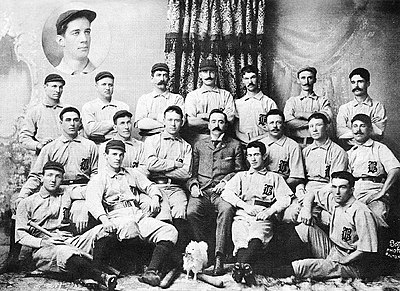
1896 Baltimore Orioles in their parlor loungewear.

This introduction to the 19th-century Hall-of-Fame team serves as both a salute and a farewell: brought in to the Classic Franchise League to provide some stiff competition for the classic franchises, they have proved to be OVERLY strong and, after some soul-searching, I have decided to remove the club from the league! After 60 games (15 games each against the 1954 Indians, the 1950 Yanks, the 1962 Dodgers, and the 1957 Braves), they are to be "retired" with a .750 winning percentage.  Before dismissing them, let's take a look at their performance:


Some notes about the batters:

- Ed Delahanty, he of the mysterious death in 1903, has been the overall hitting star. With so many great players, I didn't use a set lineup except for those players who pretty consistently delivered. He leads the club in double, homers and RBIs. Though an outfielder mainly, I mostly had him playing first base (for which he was an adequate "3"), providing some relief from an otherwise crowded outfield.
MLB-Ed Delahanty.jpg
Big bad Eddie D. channeling Tony Kubek
- George Davis was my other mainstay. He played shortstop in his career, by and large, but split his time in this league between short and third.

Photo of George Davis
George Davis and his awesome mustache

- Sam Thompson and Hugh Duffy got more time than deserved while Billy Hamilton's time was unfairly curtailed. To be fair, Hamilton's defensive rating (a '3' at all three OF positions) made me a bit nervous, particularly when installed in center.

- Cap Anson would have been a typical choice at firstbase except . . .  except I couldn't let go of my impression of him as being a prime instigator and enforcer of the so-called "color line" that prevented black players from playing alongside whites. So, I sat him. There. How do you like it, Cap? 


Pitcher observations:

- A 2.69 team ERA is awfully impressive against any competition and, of course, even more so given top-notch offenses these pitchers faced. In fact, their pitching dominance is what convinced me to pull the plug on this team just before they were about to face the 1962 Mets.

- Mickey Welch lost his last start after winning 7 straight. 

- Tim Keefe not only went 12-0 but fell one inning short of 12 straight complete games. Which shouldn't surprise anyone - in 1883 he started and completed 68 games while compiling 619 innings pitched. In one summer. I know the game was different then . . .  but c'mon! It must have been the 'stache:

Photo of Tim KeefeJamesFinlaysonPublicityHeadshot.jpg
Tim Keefe (left): inspiration for James Finlayson (right)?


So say "Hello!" and "So long!" to these 19th-century heroes (and Cap Anson). They were a fun team to manage and a victim of their own success. Had they won 2 of every 3 (as opposed to 3 of every 4) I quite likely would have kept them in the league.